Title
Artificial Intelligence: Opportunities and Risks
Introductory Description
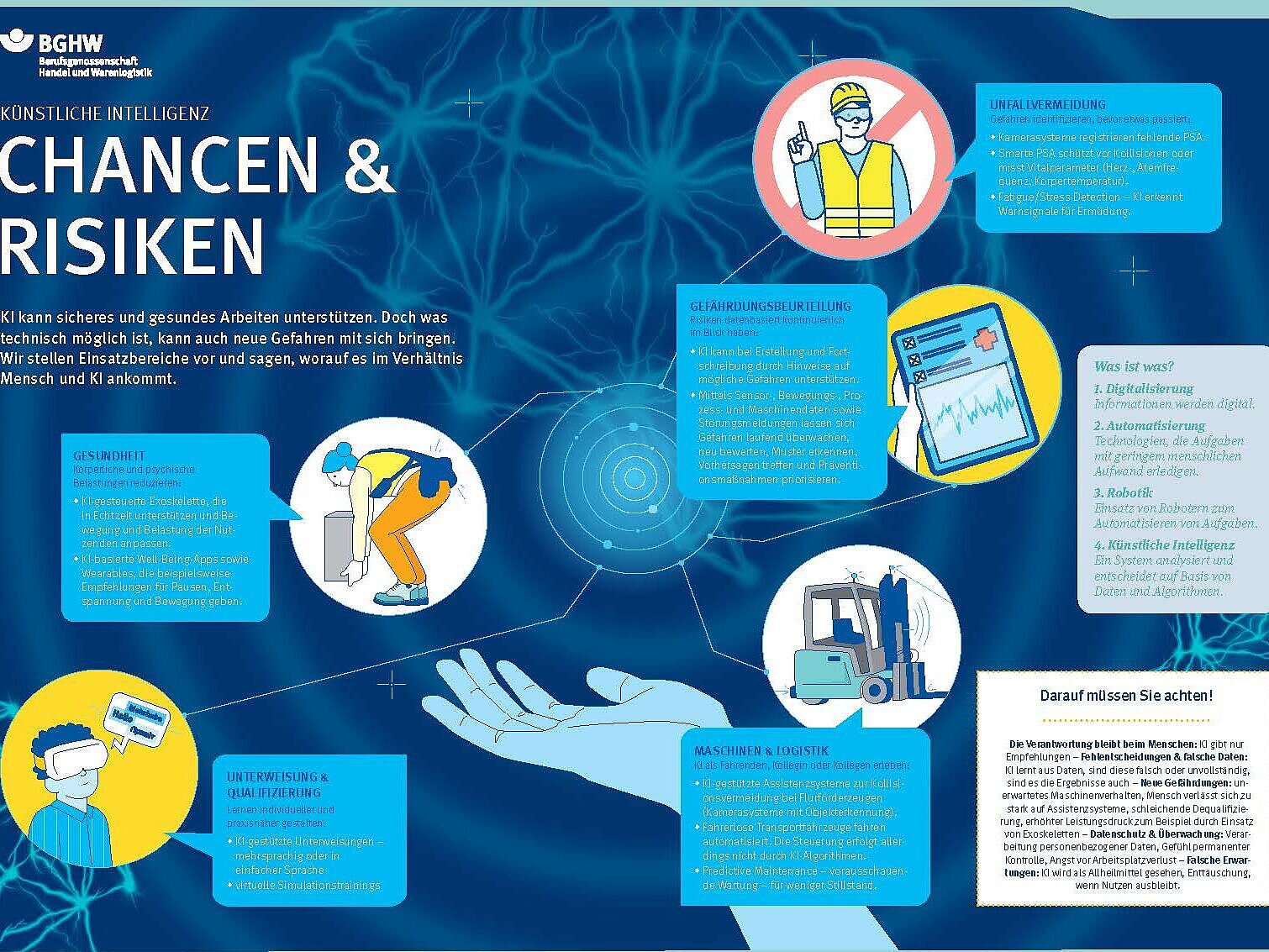
Artificial intelligence, also referred to as AI, can support a safe and healthy working environment. At the same time, new technical possibilities can also introduce new risks. This infographic presents areas where AI is used in the workplace and explains key aspects of the relationship between humans and AI.
Opportunities of Artificial Intelligence in Occupational Safety and Health
Health
AI can help reduce physical and mental strain at work.
Examples include:
- AI-controlled exoskeletons that provide real-time physical support and adapt to the user’s movements and workload.
- AI-based wellbeing apps and wearable devices that analyze personal data and give recommendations for breaks, relaxation, and physical exercise.
Accident Prevention
AI can help identify hazards before accidents occur.
Examples include:
- Camera-based systems that detect whether personal protective equipment, also called PPE, is being worn correctly.
- Smart personal protective equipment, such as helmets or clothing, that can protect against collisions or measure vital parameters like heart rate, breathing rate, and body temperature.
- Fatigue and stress detection systems in which AI recognizes warning signs of exhaustion or excessive stress.
Instruction and Qualification
AI can make learning more practice-oriented and tailored to individual needs.
Examples include:
- AI-supported instructions, available in multiple languages or in plain language.
- Virtual simulation training, allowing employees to practice tasks in a safe digital environment.
Machines and Logistics
AI can be experienced both as a driving force and as a work partner.
Examples include:
- AI-supported assistance systems for collision avoidance in industrial trucks, using camera systems with object recognition.
- Driverless vehicles that operate automatically. These vehicles are automated but not controlled by artificial intelligence algorithms.
- Predictive maintenance systems that use data to anticipate machine failures and reduce downtime.
Risk Assessment
AI can support continuous monitoring and evaluation of workplace risks.
Examples include:
- AI systems that assist in creating and updating risk assessments by highlighting potential hazards.
- The use of sensor data, movement data, process data, machine data, and fault messages to continuously monitor risks.
- Recognition of patterns, creation of predictions, and prioritisation of preventive measures based on data analysis.
Important Principles to Keep in Mind
Human Responsibility
Responsibility always remains with the human being involved. AI systems only provide recommendations and do not make final decisions.
Incorrect Decisions and Incorrect Data
AI systems learn from data. If the data is incorrect or incomplete, the results and recommendations of the AI will also be incorrect.
New Hazards
The use of AI can create new risks, such as:
- Unexpected behaviour of machines,
- Humans relying too heavily on assistance systems,
- Gradual loss of skills, also known as deskilling,
- Increased performance pressure, for example through the use of exoskeletons.
Data Protection and Surveillance
The use of AI may involve processing personal data and can lead to:
- A feeling of constant monitoring,
- Concerns about surveillance,
- Fear of job loss.
False Expectations
AI may be perceived as a universal or “miracle” solution. This can lead to disappointment if the expected benefits do not occur or do not materialise as quickly as anticipated.
Clarification of Key Terms: “What Is What?”
- Digitisation
Information is converted into digital form. - Automation
Technologies perform tasks with little or no human effort. - Robotics
The use of robots to automate tasks. - Artificial Intelligence
A system that analyses data and makes decisions based on algorithms.
Closing Description
The infographic highlights that artificial intelligence offers significant opportunities to improve occupational safety, health, and efficiency. At the same time, it emphasises that AI must be used responsibly, with humans remaining in control and with continuous attention to risks, data quality, and ethical considerations.